

Truck bed slides can look nearly identical in a catalog, yet they perform very differently in daily fleet use. Extension length, load rating, and build quality all shape how safely your team reaches its gear. Those differences add up fast when you multiply them across dozens of vehicles.
This guide walks through the main differences side by side. You’ll see where lighter units fall short and how to match a system to your fleet’s real workload.
How Truck Bed Slides Work on a Fleet Vehicle
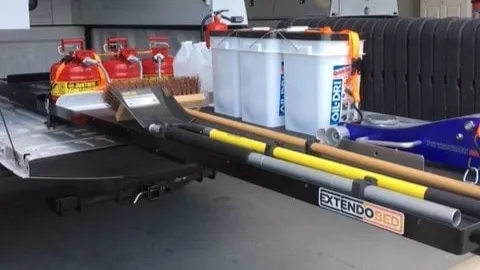
Every system starts with one simple idea. A platform rolls out of the bed, so operators can reach cargo without climbing in. At Extendobed, we call that platform the base slideout. It’s the foundation, and some customers run it on its own with nothing on top. Everything built onto it is the carrier.
A carrier can include shelves, drawers, trays, mounting walls, whiteboards, day boxes, or any mix of them. A tray, in other words, is one carrier option rather than another name for the slideout itself. When you compare truck bed slides, judge the base and the carrier separately, because each answers a different question. The base decides reach and strength, while the carrier decides organization. Our base slideout units adapt to pickups, vans, SUVs, service bodies, and trailers, so the foundation fits the vehicle first.
Extension Length Changes Everything at the Tailgate
Among truck bed slides, extension is the first spec worth checking, and it’s often the most overlooked. Many units stop short of full extension, so the front of the load stays inside the bed. Your crew then has to lean over the tailgate to grab whatever sits at the front. Over a long shift, that reaching takes a toll on backs and shoulders.
Extendobed is the only slideout that extends past 100%. Our units reach 110% and sometimes more, so the platform clears the taillights completely. Every item, front to back, sits within easy reach. The OSHA guidance on ergonomics links bending, reaching, and awkward postures to musculoskeletal injuries. Full extension removes much of that strain before it starts.
Time is the other cost. When gear comes to the operator, a crew spends seconds on retrieval instead of minutes climbing and digging. Across a full shift and a full fleet, those minutes turn into real hours. For fire and police units, faster access can also mean a faster response on scene.
Load Capacity and Weight Distribution
Load ratings vary widely, and the number on the spec sheet only tells part of the story. Our units carry from 1,000 to 3,000 pounds, depending on the build. Just as important, an Extendobed doesn’t require you to spread weight evenly across the platform. Some truck bed slides call for balanced loading, which rarely matches how crews actually pack a vehicle.
A weak platform under a lopsided load is a safety problem, not just a maintenance one. Bent rails or a failed latch can drop gear or pin a hand. Our platform holds its full rating no matter where the weight sits, so that risk drops away.
Real loads are rarely tidy. A generator, a pump, or a heavy toolbox often ends up wherever it fits best. Manual handling adds risk, too, and Oregon OSHA recommends getting help once loads reach about 35 to 40 pounds. A platform that rolls heavy gear right to the tailgate shortens every lift.
Steel, Aluminum, and Powered Options
When fleets compare truck bed slides, material is the next question, since it shapes durability and payload. Steel suits crews hauling the heaviest equipment day after day. Aluminum trims weight for vans, SUVs, and fleets watching payload closely. We build our units to outlast the trucks they ride in, and that durability drives their long-term value.
Drive type matters too. Most units extend by hand, which works well for moderate loads. For heavier builds, our Power Drive system extends and retracts the platform at the push of a button. That cuts the push-and-pull strain on operators who handle big loads. It’s a smart fit for fire and rescue units carrying heavy pumps or generators.
Some vehicles, like patrol SUVs, don’t need a sliding platform at all. Our stationary storage units give those vehicles permanent, organized space instead. It’s a separate product line, yet it shares the same build quality.
Custom vs. Off-the-Shelf Truck Bed Slides
Off-the-shelf truck bed slides appeal because they’re quick to order and cost less upfront. Fleet work rarely fits a standard box, though. Before you choose, weigh a few practical questions:
• Fit: Does the unit match your exact vehicle, bed length, and any service body or trailer?
• Layout: Can the carrier hold your actual tools, from radios to rescue gear?
• Standardization: Will every vehicle in the fleet carry gear in the same place?
• Lifespan: Will the system last through the vehicle, or need replacing halfway through?
• Lead times: Can the builder give you a clear, realistic delivery window?
Extendobed is a truly custom shop, so we design both the base and the carrier around your answers. Our units sit at the premium end of the market, and the price reflects that. Still, one system that fits right and lasts for years often beats a string of cheaper replacements.
Fleet buyers also think in totals rather than unit prices. A well-fitted build can cut lost time, strain injuries, and early replacements. Each of those shows up in the budget eventually. That’s why we encourage buyers to compare lifetime cost, not just the quote.
Finding the Right Fit for Your Fleet
The right truck bed slides for your fleet come down to reach, strength, fit, and lifespan. Extendobed built and patented the first truck bed slideout in 1987. Since then, we’ve refined it for fire, police, military, and industrial crews. Our industry-specific units show how far that custom work can stretch. We still design each one around the people who’ll use it every day.
We also believe a sale is the start of a relationship, not the end of a transaction. Follow-up service matters to us as much as the build itself. Reach out to our team, and let’s sketch out a setup that keeps your crews safe and moving.