

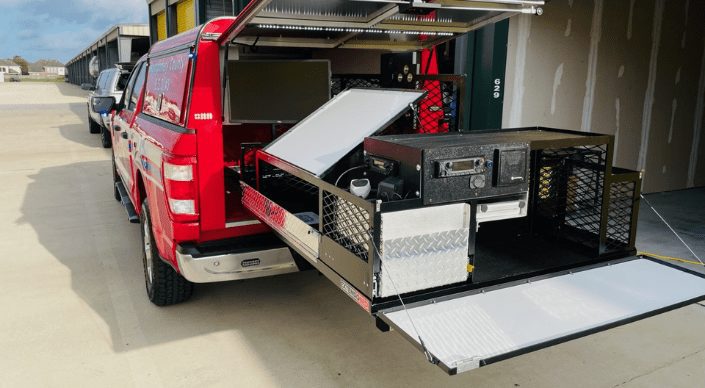
Fire scenes don’t wait for you to dig through piles of gear. By the time you’re crawling through that tailgate looking for your thermal imager, evidence is degrading, and your back’s already calling it quits for the day.
Fire and explosion investigations demand speed, precision, and reliable access to specialized equipment. Every single time you roll up. That’s where a well-configured slideout system does more than just come in handy. It keeps your gear organized, protected, and ready to deploy the second you need it.
Let’s be straight about what fire investigators haul around. This isn’t a simple toolkit; it’s a mobile lab that needs to handle everything from documentation to hazmat detection.
You’ve got cameras (usually a DSLR with an external flash for proper scene documentation), moisture meters for checking water-damage patterns, and infrared thermometers for mapping heat signatures. Add PPE like respirators, gloves, and Tyvek suits to keep you safe in contaminated environments.
Then there’s the physical evidence collection side: tweezers, swabs, sterile containers, and bagging materials for preserving samples. Don’t forget hazard-detection tools: gas meters and thermal imagers that tell you what you’re walking into before it’s too late. Without smart storage, this fire investigator equipment gets buried at the bottom of a truck bed, damaged from rattling around, or flat-out forgotten when you’re in a hurry.
Smart fire investigation storage starts with compartmentalizing by function, not just throwing everything in drawers and hoping for the best. Narrow tool racks work perfectly for small instruments and hand tools that need to stay visible and organized. Center partitions let you separate sensitive equipment from hazardous materials, because you definitely don’t want accelerant swabs cozying up next to your electronics.
Labeled drawers make the difference between finding what you need in five seconds versus five frustrating minutes. Sort by category: one drawer for PPE, another for meters and detection tools, a third for evidence kits. Full-extension drawers are non-negotiable because you need to see everything at a glance, not just what’s up front.
When you pull that drawer all the way out, every tool should be visible and within reach.
Chain of custody is the foundation of every fire investigation that’ll hold up in court. Locking drawers provide the security you need to protect evidence from tampering or accidental contamination during transport. Integrated evidence boxes take this further by creating dedicated compartments specifically designed for storing collected samples and materials.
For departments dealing with explosion-related investigations, optional ATF-compliant day boxes provide the added security and documentation requirements those cases demand.
Locking storage makes sure everything stays secure during transit and on scene.
The goal is simple: When you lock that drawer, you know the evidence inside stays protected and the chain of custody remains unbroken. That peace of mind matters when cases go to court.
A slideout system is only as good as its ability to keep gear in place when you’re hauling down rough roads or backing into tight scene locations. Containment cages prevent equipment from shifting in transit, which protects both your tools and your investment. These cages work especially well for bulkier items that might otherwise turn into projectiles on a hard turn.
Inside drawers, modular bins and dividers create dedicated spaces for specific items. It isn’t just about organization: it’s about securing liquids (like collection reagents), sharps (sampling tools), and fragile equipment (meters and sensors) inside protective enclosures.
When everything has its spot and stays put, you’re not dealing with broken equipment or spilled chemicals at the worst possible time.
Sometimes the scene doesn’t give you a clean place to work, and that tailgate’s already covered in soot. Flip-down or pull-out tables built into your slideout system provide a stable surface for field notetaking right at your fire investigator vehicle.
Integrated work surfaces are perfect for labeling evidence bags, filling out chain-of-custody forms, or organizing documentation without hunting for a flat spot or balancing paperwork on your dashboard like some kind of circus act.
These surfaces are practical and necessary. When you’re in the field and need to document findings or prep samples properly, having a dedicated workspace attached to your fire investigator truck saves time and reduces errors. It’s one less thing to improvise when the job demands your full attention.
Not every fire investigation unit runs the same type of rig, and your slideout configuration should match your vehicle’s layout. SUV setups face tighter space constraints, which means vertical storage solutions and multi-level platforms make better use of limited square footage.
You’re working with height instead of length. Think skyscraper, not ranch house.
Pickup truck beds offer more room for longer drawer systems and side-access trays that can extend well beyond the tailgate. The choice between multi-level and single-plane configurations comes down to crew size and tool load.
Solo investigators might prefer everything on one accessible level, while teams benefit from separated platforms that let multiple people access different gear simultaneously without playing bumper cars.
Speed on scene often comes down to muscle memory and visual cues. Label drawers and bins clearly by tool category or task type so anyone on your team can find what they need without playing twenty questions. Labeling is especially critical for multi-investigator teams or when you’re training new personnel who don’t yet know your system by heart.
Organize by response flow: The gear you use first should live in the easiest-to-reach compartments. PPE and initial assessment tools up front, specialized evidence collection deeper in the system. Color-coded or pre-numbered drawers keep things consistent across multiple vehicles, which matters when you’re running mutual aid calls or working with different fire investigator trucks throughout the week.
Absolutely. Multi-access configurations with side-entry and rear-entry options let multiple investigators pull gear simultaneously without blocking each other. The key is designing drawer placement so that commonly used items are accessible from multiple angles and using multi-level platforms that separate work zones. Some departments set up shared workspace drawers in the center with individual task-specific storage on the sides.
Fire scenes often happen after dark, and slideout systems can integrate lighting solutions that make a real difference. Built-in LED strips along drawer edges or under platforms provide targeted illumination exactly where you need it. The layout itself matters too. Full-extension drawers and light-colored interiors maximize visibility even in low-light conditions. Some units include rechargeable work lights mounted directly to the slideout frame.
The ergonomic benefits are huge. You’re not climbing into truck beds, overreaching into deep compartments, or lifting heavy equipment from awkward positions anymore. Everything slides out to you at waist or chest height, eliminating the repetitive bending, lifting, and twisting that can lead to back injuries over time. For investigators working multiple scenes per week, that reduction in physical strain adds up to a longer, healthier career.
Yes, and this matters for fire investigations involving hazardous materials or contaminated evidence. Center partitions and dedicated compartments create physical separation between clean PPE/documentation areas and dirty zones where contaminated samples or gear are stored. Some configurations use separate drawer banks on opposite sides of the unit, or vertical separation with clean storage on upper levels and contaminated materials below. This design approach protects evidence integrity and reduces the risk of cross-contamination.
Here’s the bottom line: A well-configured slideout system saves time, protects evidence, and keeps you working strong scene after scene. The right setup means every piece of fire investigator equipment has a home, and you can access what you need without a second thought.
That’s how the job should work.
Extendobed’s been building slideout systems since 1987, and we’ve learned a few things about what fire investigators actually need versus what looks good in a catalog. If you’re tired of fighting with your storage system when you should be focused on the investigation, it’s worth a conversation. Contact Extendobed to explore fire investigation slideout units built to make your job easier.