

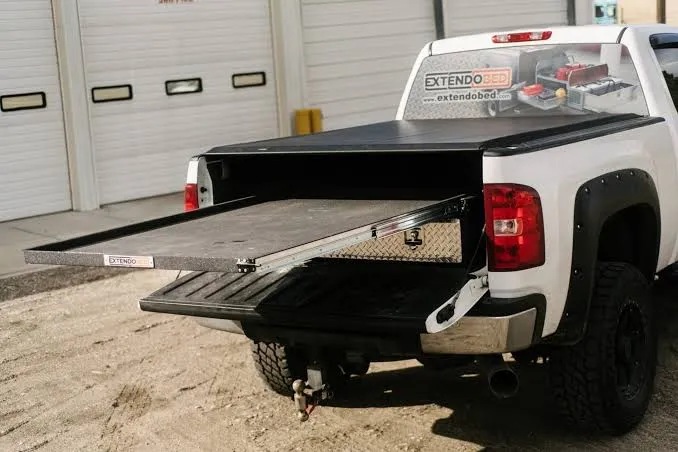
Truck bed extender options look similar on paper, but they solve very different problems on a working fleet. Some add extra length past the tailgate for long loads. Others bring the cargo itself out to the operator, so nobody has to climb in or reach deep.
For fleet managers, fire chiefs, and operations leaders, that difference shapes safety, uptime, and long-term cost. This guide breaks down the main categories and the questions worth asking before you standardize across a fleet.
What a Truck Bed Extender Does for a Working Fleet
At its simplest, a truck bed extender gives you more usable cargo space than the factory bed provides. On a personal pickup, that usually means hauling lumber or a kayak on the weekend. On a fleet vehicle, the job is much bigger. Crews need fast, safe access to tools and equipment many times per shift, often in tough conditions.
That is why fleet buyers tend to judge extension equipment on two measures. The first is how much extra length or capacity it adds. The second is how easily operators can reach the gear they carry. The best fit depends on which of those matters more for your crews.
Tailgate and Hitch-Mounted Extenders
The most familiar options fold out from the tailgate or slide into the receiver hitch. They create a cage or support frame that keeps long items from sliding off the back. For crews that haul pipe, conduit, or ladders now and then, this can be a practical, low-cost add-on. Just remember that long loads still need proper tie-downs, and the federal cargo securement rules offer a useful baseline for commercial vehicles.
These designs have real limits, though. They add length, but they do nothing to bring gear forward from the front of the bed. Operators still climb into the bed or lean over the side to reach tools near the cab. If your fleet uses a truck bed extender mainly for occasional long loads, this category may be enough. If crews unload equipment all day, it usually falls short.
Slideouts: Extending Access, Not Just Length
A truck bed slide out takes a different approach. Instead of adding a frame behind the tailgate, it puts a rolling platform in the bed that pulls out toward the operator. Extendobed created and patented the first one, a telescoping truck bed extender, back in 1987. Today, its slideout units carry load limits from 1,000 to 3,000 lb, depending on the build.
It helps to know how Extendobed describes the system. The base slideout is the foundation product, and Extendobed sizes it to fit almost any truck, van, SUV, service body, or trailer. The carrier is whatever goes on top of it. A tray is one carrier option, alongside drawers, shelves, mounting walls, whiteboards, and day boxes. Some customers run the base slideout on its own, while others combine several carrier pieces.
Extension distance matters here, too. Extendobed units reach 110% extension and sometimes more, so the platform clears the taillights completely. Gear stored at the very front of the bed ends up within easy reach. That means less climbing, less reaching, and quicker turnarounds at every stop.
How to Compare Truck Bed Extender Options
Once you know the categories, a few practical questions will narrow the field quickly. Use these as a starting checklist when you review any truck bed extender for fleet use:
- Load capacity: Confirm the rated limit at full extension, not just when the unit sits retracted.
- Extension distance: Check whether the platform clears the bumper or stops inside the bed.
- Weight distribution: Ask whether the load must sit evenly. Extendobed units have no even-weight-distribution requirement.
- Fit and customization: Look for equipment sized to your exact vehicle, body style, and daily workflow.
- Durability: Review the hardware and how the system holds up under constant daily use.
No single checklist covers every department. Still, these questions help you compare options on equal terms and avoid surprises after installation.
Safety, Ergonomics, and Liability
For many departments, safety is the deciding factor. Repeated bending, twisting, and reaching into a truck bed add up over a career. OSHA’s ergonomics guidance identifies awkward postures and forceful lifting as common risk factors for musculoskeletal injuries. A truck bed extender that brings gear to the operator removes much of that strain at the source. Fewer strain injuries also mean fewer lost workdays and lower claim costs.
Strength plays a role as well. Extendobed builds its slideouts to stay solid under heavy loads, and many units outlast the trucks they ride in. For heavier builds, the Power Drive system extends and retracts the platform at the push of a button. That cuts the force crews need to move large loads on busy shifts.
Long-Term Value Across the Fleet
Price matters, and fleet budgets rarely have room for equipment that wears out early. When you weigh any truck bed extender, look at the cost per year of service rather than the purchase price alone. Extendobed sits at the premium end of the market, and its price reflects the way the company builds each unit. A system that outlasts its truck keeps delivering value long after cheaper equipment needs replacing.
Standardization adds another layer of value. When every vehicle carries the same layout, crews find tools faster and training gets simpler. Extendobed also stands behind its products well after installation. The Extendobed warranty gives fleet managers a clear reference point during budget reviews. That follow-up support matters as much as the hardware itself.
Choosing the Right Setup for Your Crews
The right truck bed extender depends on what your crews carry and how often they reach for it. Tailgate and hitch-mounted frames handle occasional long loads well. For daily access, safety, and fleet-wide consistency, a custom slideout usually earns its place. Stationary drawer systems are another option when a vehicle does not need extension at all.
Extendobed has spent nearly four decades building these systems for fire, law enforcement, military, and industrial fleets. The team focuses on long-term relationships, with follow-up service that continues well past delivery. If you are weighing options for your next upfit, reach out to the Extendobed team and talk through what your crews need day to day.