

Service managers don’t ask whether a truck bed slide-out looks good. They ask whether it pays for itself. Poor service truck organization and disorganized work truck storage cost fleets money every day, even when no one tracks it on a line item.
Every fleet already pays for bad service truck storage, even if it never shows up on a line item labeled that way. The cost usually lands in two places:
None of this shows up clearly until you add it up across your fleet.
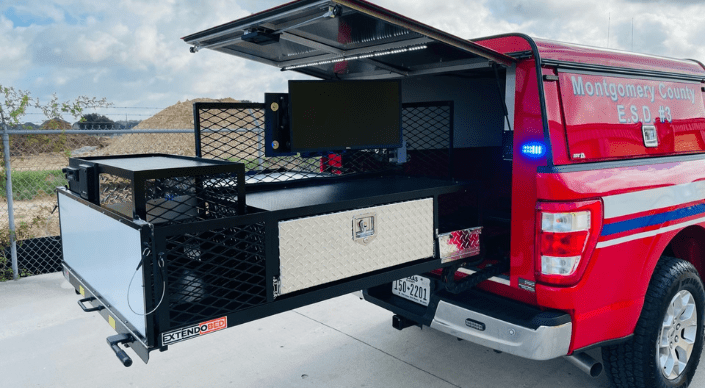
A truck bed slide-out solves the access problem directly. Because the platform extends past the tailgate, in some cases up to 110% of the bed length, your technicians can see and reach the entire load from ground level instead of climbing in and moving gear aside to get to what is stored at the front. No climbing. No digging.
Shaving even a few minutes off tool retrieval on every stop adds up fast. A technician making eight stops a day recovers real working time every week, and that time scales across every truck running the same route structure.
Overexertion injuries, the kind caused by lifting, reaching, and awkward carrying, are one of the most expensive categories of workplace injury across every industry. Liberty Mutual’s Workplace Safety Index puts the direct employer cost of overexertion injuries at more than $15 billion a year, and musculoskeletal injuries account for roughly a third of all lost-workday claims.
That figure spans every industry, not just service fleets, but the mechanism behind it shows up in a truck bed too: climbing into a pickup or cargo van and reaching for gear stored deep in the bed puts repeated strain on the lower back and shoulders. A slide-out that brings the load to the technician instead of the other way around removes a real share of that strain.
Extendobed’s optional Power Drive motorized extension goes a step further, taking the physical effort out of moving a fully loaded tray.
A loose bed full of sliding tools and parts damages your gear and your truck. A heavy-duty slide-out protects both in three ways:
The math is simpler than most fleet managers expect. Take your stops per day, multiply by the minutes saved per stop from faster access, then multiply by the technician’s fully loaded hourly cost.
For illustration only, using round numbers: a technician making eight stops a day who saves five minutes per stop recovers about 40 minutes daily, about three hours and 20 minutes a week. At a loaded labor rate of 60 dollars an hour, that is about 200 dollars a week in recovered time on a single truck, before counting fewer reaching injuries or repeat trips for a missed tool. Run the same formula with your own stop counts and labor rate, then multiply by the number of trucks you plan to upfit.
Most service and utility fleets run more than one vehicle type. Pickups, cargo vans, and the occasional SUV end up on the same route board, and a mismatched set of storage solutions makes training, restocking, and inspection harder than it needs to be.
Extendobed builds slide-out and stationary drawer units sized for pickups, vans, and SUVs, so your fleet vehicle storage can follow the same loading pattern and inspection checklist across vehicle types even when the vehicles themselves don’t match. Cargo van storage and pickup bed storage end up working the same way for the crew, which is what makes standardizing across a mixed fleet realistic.
For fleets running heavy or mixed daily loads, most crews recover the added cost through faster stops and fewer reaching injuries within a year or two. Payback depends on stop volume, labor rate, and current injury exposure. Run the math above using your own numbers.
Full extension means the technician sees and reaches the whole load without climbing into the bed or moving gear aside, cutting the minutes spent searching for the right tool or part on every stop.
Reducing the deep reaching and awkward lifting that comes with digging through a loaded bed removes a real source of overexertion strain, one of the costliest categories of workplace injury industry-wide. It won’t eliminate every claim, but it removes a specific, repeated risk.
A well-built slide-out rated for the actual load a crew hauls is designed to last for the working life of the truck, provided it is not loaded beyond its rating.
Start with one truck. Track stops per day, minutes saved per stop, and the technician’s loaded hourly rate, then multiply that weekly savings by the number of trucks you plan to upfit.
If your fleet is ready to see what full access does for time per call and technician safety, Extendobed’s heavy-duty slide-out units are built for daily service and utility work, with load ratings up to 3,000 pounds and configurations for pickups, vans, and SUVs. Every unit is manufactured in the USA, and Extendobed has been building slide-out systems since 1987. Contact Extendobed to run the numbers on your own fleet.