

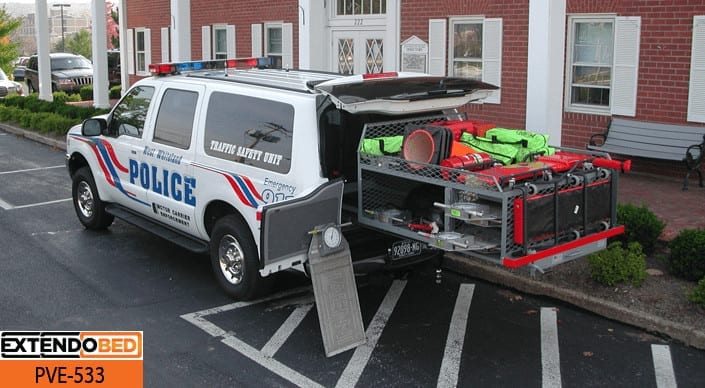
A traffic enforcement vehicle is always in use. Officers are continually out of the vehicle, managing portable scales, road cones, spike strips, signage, and first-aid gear, often on a busy highway shoulder with limited time and restricted visibility. In these situations, the vehicle must keep up.
Standard police upfits handle weapons and patrol gear well. Traffic enforcement upfits are a different problem. The equipment is larger, heavier, more varied, and more sensitive. Without the right storage systems in place, gear can shift during transport, scales get damaged, and officers waste time digging through compartments they cannot see into at night.
What Traffic Units Carry
The inventory in a traffic enforcement vehicle is more varied than that of most patrol units. Officers typically manage the equipment noted below:
- Portable scales (axle and wheel position), often in padded carrying cases
- Traffic cones and foldable delineators
- Road flares and electronic flares
- Spike strips and traffic spike systems
- Citation books, tablets, and handheld radar units
- First-aid kits, trauma bags, and basic medical supplies
- Reflective vests, rain gear, and high-visibility signage
- Scene lighting equipment
The weight and bulk of this inventory drive every storage decision. Scales specifically require dedicated mounting or cushioned compartments. A scale that slides around in a bare truck bed will need calibration at the worst possible time.
Scale Racks and Compartments: Protecting Sensitive Equipment
Portable scales are the most equipment-intensive item that most traffic units carry. They are expensive, require regular calibration, and can be knocked out of service by rough handling during transport.
Scale racks built for traffic enforcement upfits hold each unit securely in a fixed position, with locking mounts that prevent movement. The goal is the same every time: the scale leaves the vehicle in the same condition in which it arrived.
Compartment placement matters here. Scales that officers reach for multiple times per shift should be positioned for fast access without requiring them to step into a truck bed or lift a heavy lid. Low-profile, slide-out-accessible compartments at bumper or load-floor height are the right answer for most pickup configurations.
Slide-Out Storage for Cones, Flares, and Traffic Control Equipment
Cones and flares have a storage problem: they are bulky, must be readily accessible, and typically come in bulk. Officers deploying equipment at a traffic scene do not have time to rearrange gear to reach what they need at the bottom of the load.
Slide-out storage systems solve this issue directly. A full-extension drawer or slide-out platform lets an officer pull the entire storage section out from the truck bed, access every item in a single layer, and load or unload without climbing into the vehicle. The Idaho Traffic Unit configuration is a strong example of how this system works in practice, with cones and flares staged in separate accessible zones.
Pickup Truck vs. SUV Configurations
Pickup trucks offer more raw storage volume in the bed, which works well for high-cone-count configurations. Slide-out systems integrate cleanly into a truck bed and support significant weight capacity.
SUVs require a different approach. The enclosed cargo area limits the footprint available for slide-out systems, and weight distribution becomes a more active consideration. Modular drawer systems that fit within the cargo area while keeping the load floor accessible are the standard solution. The trade-off is carrying capacity, which means an SUV-based traffic unit may need to prioritize its inventory more carefully than a pickup-based equivalent.
Fold-Down Writing Tables and Pull-Out Desks for Roadside Paperwork
Citations, weight tickets, and incident documentation are still paper-dependent in most jurisdictions. Officers writing tickets or completing forms at the roadside need a stable writing surface, not a clipboard balanced on a steering wheel.
Fold-down writing tables and pull-out desk surfaces provide a dedicated workspace that stows flat when not in use. Mounted at the driver’s side or passenger side, depending on configuration, these surfaces give officers a consistent place to work without adding permanent bulk to the cab or cargo area.
For two-officer units, a passenger-side surface adds a second workspace without requiring one officer to lean across the vehicle. The Garland Police Department’s configuration demonstrates how this layout supports parallel work when two officers are on scene.
Full-Extension Drawers for First Aid, Tools, and Gear
First-aid kits, trauma bags, and emergency tools must be quickly findable. In a high-stress roadside situation, an officer does not have time to search. Full-extension drawers that pull completely clear of the vehicle frame give immediate visibility to everything stored inside.
Drawer positioning in a traffic upfit should reflect frequency of use. First-aid kits and trauma gear belong in a dedicated, labeled drawer at an easily reachable height. Infrequently used equipment can go into deeper storage. The principle is simple: the faster an officer needs it, the more accessible it needs to be.
Lockable drawers are standard for medication and controlled-substance storage. Locking mechanisms on general-gear drawers prevent movement during transport and eliminate the risk of a drawer sliding open while driving on rough roads.
Weight Distribution in Pickups and SUVs
Traffic enforcement vehicles carry more concentrated weight than most patrol units, and that weight is often positioned in the rear of the vehicle. Poorly distributed loads affect braking, handling, and tire wear, which matters when driving a vehicle on highways at speed.
A well-designed traffic upfit positions heavier items, scales, tool drawers, and lighting equipment as close to the axle as possible and as low in the vehicle as practical. Slide-out systems help in this situation, since they allow heavy items to be stored lower in the bed rather than stacked on top of other gear.
For SUVs, weight distribution is a more acute constraint. Fleet managers specifying a traffic upfit for an SUV should review the vehicle’s payload rating against the full loaded weight of the intended equipment inventory before finalizing the storage configuration.
Configuring for One or Two Officers
Single-officer traffic units need everything accessible from the driver’s side. Storage layout should prioritize items the officer reaches for most often on the driver’s side of the vehicle, with less frequent items on the opposite side or at the rear.
Two-officer units require a different spatial logic. Shared equipment must be reachable from both sides without either officer having to cross the vehicle. Rear-access storage and side-access compartments work better for two-officer configurations than strictly driver-side setups.
This question should be settled before finalizing a storage design. A layout optimized for a single officer will feel congested and inefficient for a two-officer crew, and vice versa.
Frequently Asked Questions
What equipment do officers use most frequently during traffic stops?
Scales, citation books or tablets, traffic cones, and first-aid kits are the most frequently accessed items. These should be in the lowest-reach, most accessible positions in the storage configuration.
How can portable scales be stored to prevent damage?
Scales should be stored in dedicated mounts or cushioned compartments that prevent movement during transport. Slide-out access at load-floor height reduces handling and the risk of dropping during retrieval.
Should the unit be configured for one or two officers?
This decision drives the entire layout. Single-officer units optimize for driver-side access. Two-officer units need shared rear and side access. Confirm the staffing model before specifying storage positions.
What additional storage considerations arise when using an SUV vs. a pickup?
SUVs have a smaller enclosed cargo area that limits the size and number of slide-out systems that will fit. Payload ratings are also more constrained. Traffic enforcement upfits for SUVs require a tighter inventory prioritization and should be reviewed against the vehicle’s rated payload before specification is finalized.
Build a Traffic Unit That Keeps Up
Extendobed engineers purpose-built storage solutions for law enforcement and public safety vehicles. From scale racks and slide-out systems to fold-down writing tables and full-extension drawers, they designed every configuration for how officers work.
See Extendobed’s law enforcement upfitting solutions or contact the team to discuss your fleet’s requirements.