Made in the USA

MANUFACTURED IN THE USA

(800) 752-0706

Chat With Our Team

Search
Made in the USA

MANUFACTURED IN THE USA

Essential Pieces of Equipment Every Firefighter Needs

March 08, 2022

Essential Pieces of Equipment Every Firefighter Needs

Essential Pieces of Equipment Every Firefighter Needs

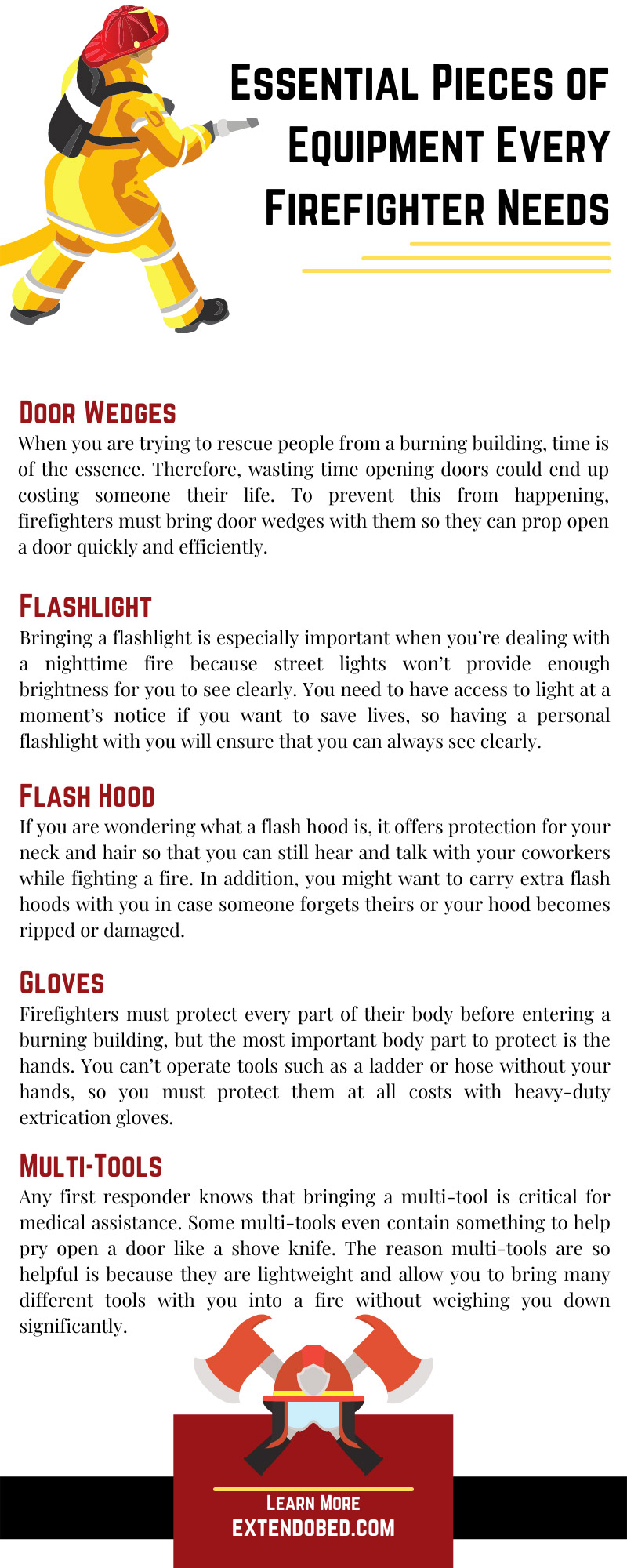
Being a firefighter is one of the toughest jobs around. Nevertheless, it is also one of the most essential occupations because firefighters keep us safe. However, since firefighters can’t fight fires with their bare hands, they must use helpful equipment to get the job done.

If you are a current firefighter or plan on becoming one, you need to know which types of gear are essential for this line of work. Firefighters use many different kinds of tools for a variety of purposes, and in this guide, you will learn about all of them. With this in mind, here are the essential pieces of equipment every firefighter needs.

Door Wedges

When you are trying to rescue people from a burning building, time is of the essence. Therefore, wasting time

 opening doors could end up costing someone their life. To prevent this from happening, firefighters must bring door wedges with them so they can prop open a door quickly and efficiently.

These items are easy to use and dirt cheap, so replacing them is a breeze if they don’t survive the fire. Wedging a door open allows firefighters to maneuver through a burning building faster. Depending on how many doors are in the building, you might want to bring about seven or eight wedges with you to each place, but since they are small, it won’t feel like a burden to carry that many.

Flashlight

Due to the potential visibility issues that might arise from the presence of smoke and lack of electricity, firefighters must carry flashlights with them before leaving the firehouse. Bringing a flashlight is especially important when you’re dealing with a nighttime fire because street lights won’t provide enough brightness for you to see clearly. You need to have access to light at a moment’s notice if you want to save lives, so having a personal flashlight with you will ensure that you can always see clearly.

Flash Hood

If you are wondering what a flash hood is, it offers protection for your neck and hair so that you can still hear and talk with your coworkers while fighting a fire. In addition, you might want to carry extra flash hoods with you in case someone forgets theirs or your hood becomes ripped or damaged.

All you must do is store the extra flash hood in your helmet to transport it easily with you to the scene. However, if you plan to purchase some extra ones, make sure that they are flame-retardant because there are similar types of flash hoods that are vulnerable to fires.

Gloves

Firefighters must protect every part of their body before entering a burning building, but the most important body part to protect is the hands. You can’t operate tools such as a ladder or hose without your hands, so you must protect them at all costs with heavy-duty extrication gloves.

These gloves prevent your hands from getting burnt, so you will want to bring two pairs with you to each fire in case one of the pairs becomes lost or damaged. Extrication gloves also protect your hands from debris, abrasions, and cuts, so your hands are fully protected while you fight the fire.

Multi-Tools

Any first responder knows that bringing a multi-tool is critical for medical assistance. Some multi-tools even

 contain something to help pry open a door like a shove knife. The reason multi-tools are so helpful is because they are lightweight and allow you to bring many different tools with you into a fire without weighing you down significantly.

Since all your tools will be on one device, you can use it for almost any circumstance you encounter when fighting a fire. Nonetheless, you must familiarize yourself with the specific multi-tool you have before entering a fire, or else you could waste time trying to figure it out at the scene.

Shove Knife

Doors are a major obstacle when you’re fighting a fire. If you are fighting a fire and run into a door that is locked or jammed shut, then you would use a shove knife to separate the door from the frame.

Using the door frame as a fulcrum, the shove knife serves as a lever that forces the door open so that you can run in and help people. If done correctly, you won’t even damage a door by using a shove knife. However, this all depends on whether any complications arise during the process.

Hose Straps

Driving to a fire with a tangled-up hose will guarantee that disaster will strike. Thankfully, you can prevent this from happening by using hose straps to tie up your hose nicely.

Using nylon hose straps can help you easily store your hose so that it’s ready to go when you arrive at the scene. Hose straps also serve other purposes, such as helping to stabilize a burn victim during transport, securing a door open or closed, and keeping your hose line straight.

Snagger Tool

Snagger tools are extremely useful for firefighters because they can assist you with many tasks. In essence, a snagger tool is just a piece of metal shaped like the letter S with a spike on the end of it.

Nonetheless, you can use a snagger tool to get a better grip on your fire hose, smash through gla

ss windows, remove a windshield to help someone escape a burning vehicle, and cut through drywall and ceiling boards to get someone out of a room. The snagger tool takes the brunt of the damage, so a firefighter won’t have to risk injuring themselves when they use one to cut through a wall or window.

Escape Rope

Finally, every firefighter can consider bringing an escape rope into a fire with them, so they don’t wind up being stranded on the upper levels of a building. Escape ropes allow you to climb down safely so that you can quickly reach the ground without injuring yourself. If you are strong enough, you should also be able to carry other people with you by using a harness to rappel.

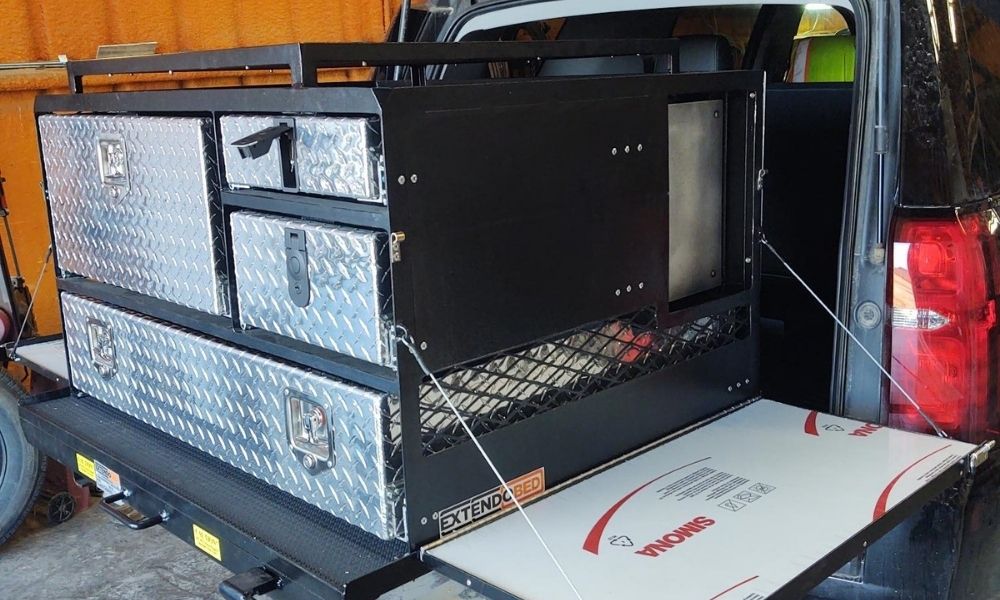
Overall, having the right tools is a critical factor in your success as a firefighter. Additionally, you will want to purchase a firefighter pull-out truck bed storage unit so you can transport all your gear and access it easily. Now that you know about the essential pieces of equipment every firefighter needs, you can effectively work towards saving lives whenever the next fire breaks out.
Essential Pieces of Equipment Every Firefighter Needs

Sticky

What an HVAC Technician Should Have in Their Trunk

February 28, 2022

What an HVAC Technician Should Have in Their Trunk

What an HVAC Technician Should Have in Their Trunk

Whether you live in an area that experiences extreme heat or harsh winter weather, you probably benefit from having a working HVAC system in your home. Nonetheless, when your system malfunctions, you need to call an HVAC repair technician.

If you are an HVAC technician, then you know that what you bring with you to each job will determine whether you can perform your job properly or not. With this in mind, here is what an HVAC technician should have in their trunk.

Hand Tools

The main things that HVAC technicians should carry in their trunks are standard hand tools. These items include hammers, wire cutters, screwdrivers, pliers, tin snips,a sawz-all and drills.

Since HVAC technicians often must go into some hard-to-reach places, they should also carry a flashlight with them since there probably won’t be adequate lighting in some areas. HVAC technicians use these tools for many different tasks, and they are a must-have item for any handyperson.

A Sliding Storage Trunk

Since HVAC technicians need to carry so many tools to each job, they should have a dedicated storage solution for their equipment. Most HVAC technicians drive either a cargo van or a pickup truck, which allows them to store a vast amount of gear. However, these items can slide around in the cargo area and get damaged since there is so much space. They can also be difficult to load and unload to get to needed tools or equipment that has been stacked in the vehicle.

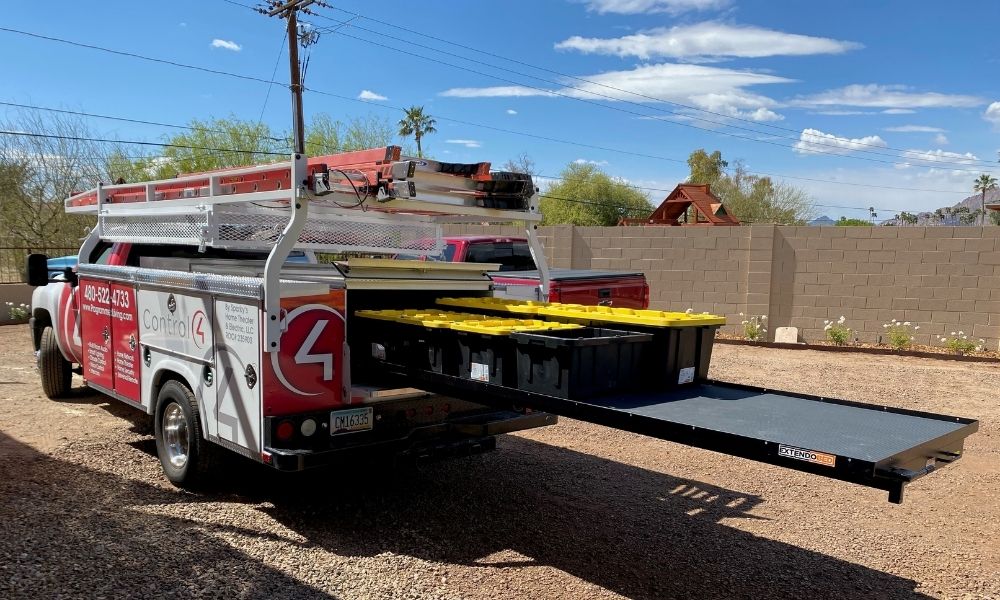
For this reason, HVAC technicians should invest in vehicle aluminum storage trunks. These sliding devices allow you to access your equipment without entering your truck bed or cargo space. With a sliding storage trunk at your disposal, you can save time and focus on repairing HVAC equipment rather than digging through piles of gear until you find what you’re looking for.

HVAC Components

This should go without saying, but any HVAC technician should bring along basic components for any HVAC system to each job. Some examples of such items include air filters, clamps, refrigeration gauges, extra refrigeration fluid, and various pipe fittings.

Many HVAC technicians will have a reactive approach to their job rather than a proactive one. By bringing these components to each job, you can ensure that you will be able to finish a job without having to go get something, impress your customers and speed up the overall time on the job site, making you available to complete more jobs in a day and being more productive.

Overall, working as an HVAC technician is not easy. Nevertheless, now that you know what an HVAC technician should have in their trunk, you can perform this job more effectively thanks to possessing the proper equipment.

Sticky

Essential Tips for Protecting Your Load on a Pickup Truck

February 28, 2022

Essential Tips for Protecting Your Load on a Pickup Truck

Essential Tips for Protecting Your Load on a Pickup Truck

Picture this: you’re driving your pickup truck on a long stretch of road for work when some items fall out of the back of your truck bed. How would you go about retrieving them? What are you going to tell your client, customer or supervisor when they find out an item is damaged or lost?

Whatever the case may be, this is a situation that you definitely want to avoid. If you ever worry about this type of scenario happening to your vehicle, then you need to learn the essential tips for protecting your load on a pickup truck.

Luckily, this guide will help you learn everything you need to know about this topic. So, without further ado, here are the steps for making sure that your load is always secure.

Always Carry the Proper Equipment

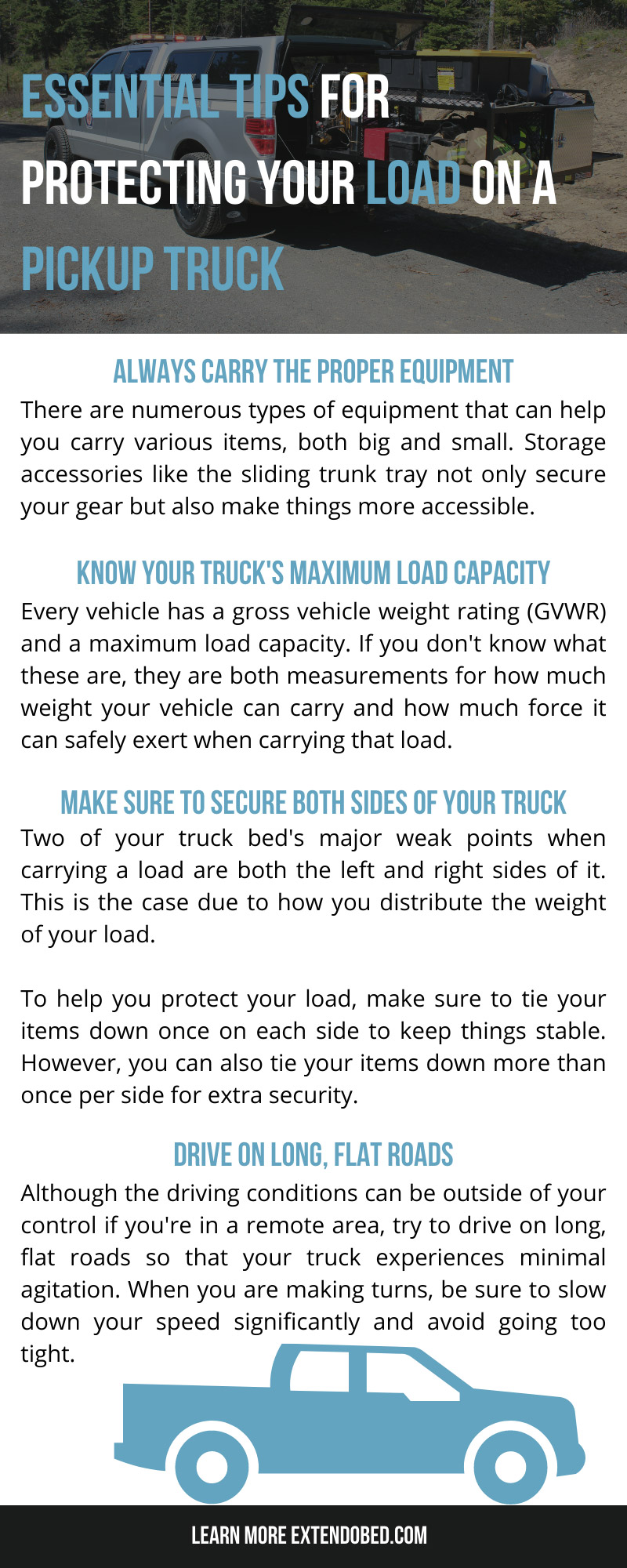
Although truck beds provide you with plenty of open space to carry a variety of loads, this can actually be detrimental to keeping your items secure because they will slide around in the back. For this reason, items like an industrial truck sliding trunk tray might be something that you want to put on your shopping list.

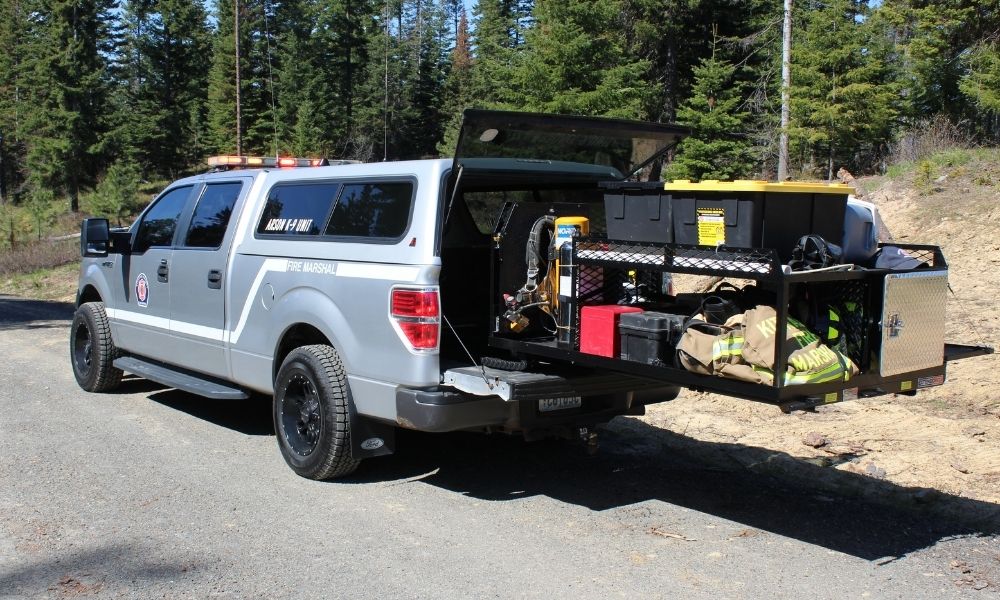
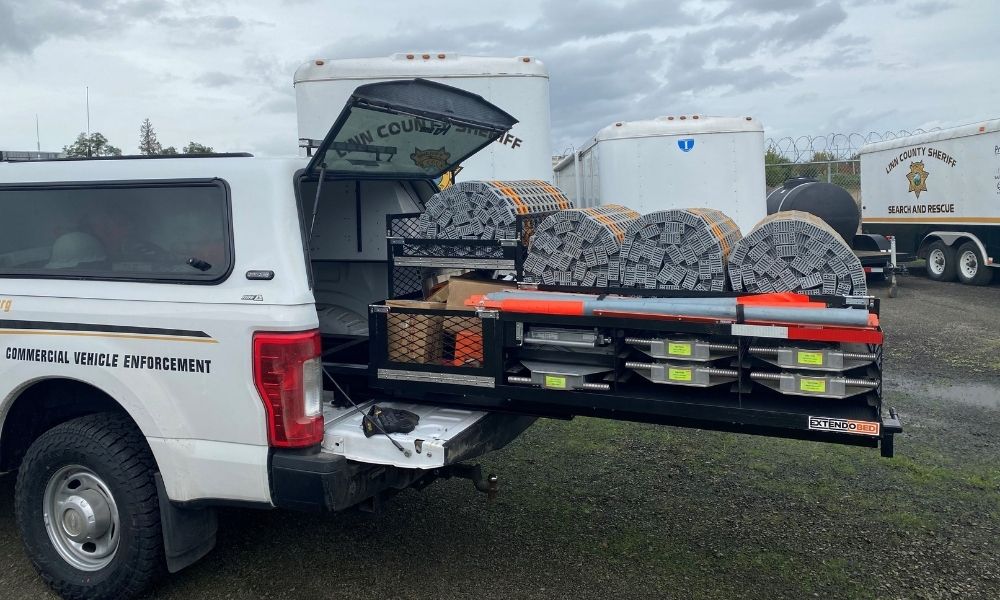
There are numerous types of equipment that can help you carry various items, both big and small. Storage accessories like the sliding trunk tray not only secure your gear but also make things more accessible. For example, instead of getting in and out of the truck bed whenever you need to grab a tool, sliding trunk trays allow you to pull out the tray and grab it without ever climbing into the back of your vehicle.

Furthermore, you can lock your things up when you aren’t using them, giving you extra security when you’re driving. Other items that you might want to consider for helping to secure your load include bungee cords, tarps, or ratchet straps if you are only transporting a few items at a time.

Know Your Truck’s Maximum Load Capacity

Additional accessories can help you carry and tow large objects, but you should still know your truck’s maximum load capacity regardless of which items you are working with. If you fail to stay under your truck’s max load, you could risk damaging your vehicle, your load, or both.

Every vehicle has a gross vehicle weight rating (GVWR) and a maximum load capacity. If you don’t know what these are, they are both measurements for how much weight your vehicle can carry and how much force it can safely exert when carrying that load.

The label on the inside of the door to your driver’s seat should give you this information, but if you can’t find it, you can look it up in the owner’s manual or online. Nevertheless, you never want to be unsure of your truck’s maximum load capacity because you don’t want to risk exceeding the limit.

Keep Your Heaviest Objects at the Front of Your Truck Bed

One of the most critical factors of protecting your load is to distribute the weight evenly. What this means is that you don’t want to have your smaller items crushed by larger items, and you also don’t want uneven weight distribution to affect how you handle your driving.

As you load items into your truck bed, start with the heaviest ones and push them towards the front of your vehicle. This will prevent your truck’s back end from weighing down the rest of your vehicle, which can affect your power steering ability on the front end. In addition, you will want to distribute the weight of your load so that it’s even on the left and right of your truck bed.

Make Sure To Secure Both Sides of Your Truck

Two of your truck bed’s major weak points when carrying a load are both the left and right sides of it. This is the case due to how you distribute the weight of your load.

To help you protect your load, make sure to tie your items down once on each side to keep things stable. However, you can also tie your items down more than once per side for extra security.

Tying things down will limit the motion of each item, which prevents everything from banging into each other. When objects move around too much in your truck bed, they could damage your truck or fall out of the vehicle entirely. This occurrence could lead to the vehicle behind you getting into a deadly accident, which is why it’s vital to secure your items properly.

Drive On Long, Flat Roads

Although the driving conditions can be outside of your control if you’re in a remote area, try to drive on long, flat roads so that your truck experiences minimal agitation. When you are making turns, be sure to slow down your speed significantly and avoid going too tight.

Also, never slam on the brakes when you’re carrying a large load because you could injury yourself when the objects come flying forwards. Any slight bump could lead to enormous consequences if your load falls out of your truck, so by maintaining a constant, steady speed on roads that are long and flat, you can reduce the chances of collateral damage.

Use a Flag When Your Load Extends Beyond Your Truck Bed

There are laws in place that require you to use a red flag to warn other drivers that you are carrying an oversized load. You can purchase this type of flag from virtually any hardware or auto goods store. If your load extends far beyond the edge of your truck bed, then you must use a flag or a similar piece of cloth to make other drivers aware of their surroundings.

Although drivers should be able to see you, sometimes they can’t tell how much room they have between your vehicle and theirs. The worst-case scenario would be for someone to crash into your load because there wasn’t enough space. But if they see the red flag, it will let them know they need to back up.

Overall, protecting your load is about more than just keeping things in the right place. It also means that you are protecting yourself and the drivers around you. Now that you know the essential tips for protecting your load on a pickup truck, you can drive more safely and effectively to your next job.

Essential Tips for Protecting Your Load on a Pickup Truck

Sticky

Tips for Making Your Patrol Vehicle More Organized

February 23, 2022

Tips for Making Your Patrol Vehicle More Organized

Tips for Making Your Patrol Vehicle More Organized

As a police officer, you must work with a variety of tools to carry out your operations. However, in an emergency, you don’t have much time to go through your entire collection just to find one item.

Thankfully, there are a few ways for every officer to organize their vehicle more efficiently. With this in mind, here are some tips for making your patrol vehicle more organized.

Use Console Accessories To Organize Your Cab

Unless you are investigating an area, you will spend most of your time as a police officer in your patrol car’s cab. For this reason, it is essential that you organize this area effectively.

Losing track of important papers, citation booklets, and other items can cost you your job, but if you organize your cab, you won’t have to worry about this outcome. You can use console accessories such as a storage box or cupholders to keep track of all the smaller items.

Keep Your Firearms Secure

Although most of the public think you should always have your weapons readily available in case of an emergency, this is not the case. In fact, when appropriate, secure your firearms with a weapon vault so that you can keep them out of reach from the public—as well as criminals.

Other than the handgun you keep in your holster, you don’t need to carry other weapons on you all the time. Storing your other weapons in a secure environment will ensure that they don’t get into the wrong hands.

Make Sure That Everything in Your Trunk Is Accessible

The trunk is generally the messiest area in any patrol car because it’s easy to throw miscellaneous items in there and forget about them. Nonetheless, if this mess gets out of hand, you won’t be able to reach critical items when disasters occur.

This is why you need to purchase a police car trunk organizer if you don’t have one already. These devices help you keep track of all the necessary tools for keeping the public safe—from defense equipment to medical gear.

Overall, working as a police officer is quite difficult, and having a messy patrol car only makes it that much harder. However, now that you know a few tips for making your patrol vehicle more organized, you can ensure that everything you need is readily available during crucial moments.

Sticky

Reasons Why Your Vehicle Needs a Trunk Organizer

February 16, 2022

Reasons Why Your Vehicle Needs a Trunk Organizer

Reasons Why Your Vehicle Needs a Trunk Organizer

No matter what line of work you’re in, if you carry equipment with you in your vehicle, you need a trunk organizer. Although cargo vans and pickup trucks have large payload capacities and extensive storage capabilities, your gear can quickly turn into a cluttered mess if you don’t organize it in an efficient manner. There are numerous reasons why your vehicle needs a trunk organizer, so here are three major benefits you gain from purchasing one.

It Prevents Protects Your Equipment From Damage

Whether you work as a contractor or as a first responder, you must bring invaluable tools with you in order to perform your job correctly. However, if you don’t secure your tools to something stable, they’ll move around in your trunk while you’re driving. One sharp turn could cost you a lot of money to repair or replace those tools. Luckily, if you consolidate your gear with a trunk organizer in the bed of your tuck or in the cargo area of your van you won’t have to worry about damaging anything of value.

Accessing Your Gear Becomes Much Easier

How many times have you struggled to find a piece of equipment because your trunk was disorganized? If the answer is too many to count, then your life will become much easier if you purchase a trunk organizer. As the old saying goes, “time is money,” and cutting down on the time you spend looking for your precious gear will allow you to be more productive. This is especially salient for first responders because when they need to find life-saving equipment to help in an emergency, there’s no time to waste.

It Keeps You Safer Overall

Driving with large pieces of equipment can be dangerous if they aren’t secure. If you drive a van, a piece of gear could come flying at you while you’re driving if you don’t have a partition. Although you won’t get hit when driving a pickup truck, a significant clatter could alter your vehicle’s weight distribution and lead to an accident. Thankfully, you can avoid these problems with a heavy-duty trunk organizer to keep all your gear in one place.

In short, trunk organizers offer countless practical benefits that are too great to ignore. Now that you know these three reasons why your vehicle needs a trunk organizer, be sure to order one sometime in the near future.

reasons why your vehicle needs a trunk organizer, be sure to order one sometime in the near future.

Sticky

Innovative Truck Storage Ideas

February 16, 2022

Innovative Truck Storage Ideas

Innovative Truck Storage Ideas

Trucks are one of the most versatile vehicles available. Not only can you carry all sorts of equipment in them, but they also come in various shapes and sizes. That way, you can tailor yours to any job you need it to perform.

However, if you demand a lot from your truck, you may want to seek out new ways to maximize and optimize storage in your vehicle. With this in mind, here is your guide on a few innovative truck storage ideas.

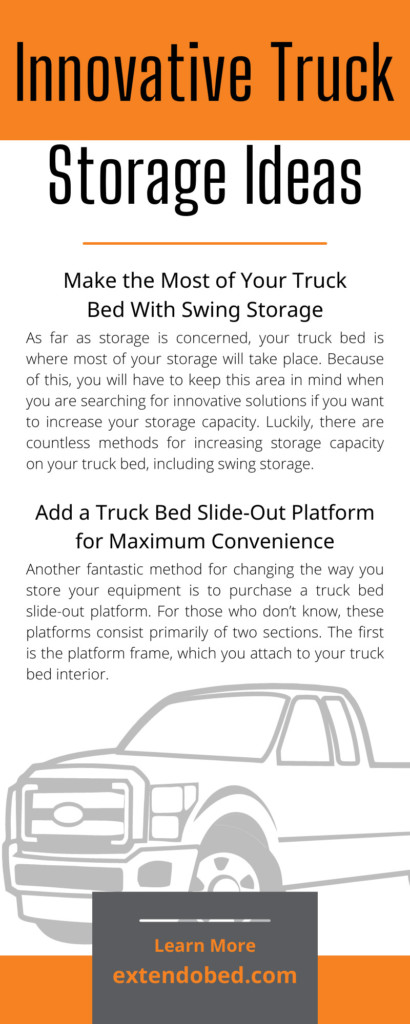
Make the Most of Your Truck Bed With Swing Storage

As far as storage is concerned, your truck bed is where most of your storage will take place. Because of this, you will have to keep this area in mind when you are searching for innovative solutions if you want to increase your storage capacity. Luckily, there are countless methods for increasing storage capacity on your truck bed, including swing storage.

Essentially, the purpose of a swing case is for you to access your gear without having to enter the truck bed. Instead, the swing case is on a hinge that lets you “swing” your toolbox to the edge of the truck bed.

However, not all trucks are compatible with this type of storage, so make sure that your truck’s specifications match the ones suited for the swing case that you intend on purchasing. One of the top advantages of using a swing box is you can secure them with a heavy-duty lock so that no one can take your tools. In addition, the interior design of these cases makes them ideal for many gear types.

On top of each one, you will find a tray for storing smaller tools, such as drills and screwdrivers. This makes a swing case handy for construction workers and tradespeople.

When traditional toolboxes are in short supply, handypersons may feel tempted to opt for a swing box instead. Switching to a swing box is easy since they don’t take up as much space as a standard toolbox.

If you mount a toolbox to the truck cabin, it can take up a significant amount of space in your truck bed. However, you don’t have to worry if you use a swing case.

Add a Truck Bed Slide-Out Platform for Maximum Convenience

Another fantastic method for changing the way you store your equipment is to purchase a truck bed slide-out platform. For those who don’t know, these platforms consist primarily of two sections. The first is the platform frame, which you attach to your truck bed interior.

The other component is the sliding bed/drawer on which you place all your items. This section moves on track so that you can pull items in and out of your truck bed with the greatest of ease. These sliding beds can also be modified with cargo carriers to further help organize the items in your truck or van bed.

When you’re determining which model you may be interested in, it helps to know about the different types of materials that these platforms come from. Some manufacturers produce slide-out platforms with steel or aluminum, but other platforms will come with a deck with an embedded pattern for increased friction. This friction makes it less likely for someone to slip when walking on the platform, and it also reduces the likelihood of gears sliding around in the truck bed while you’re driving.

In terms of maximizing storage capabilities for your truck bed, slide-out platforms offer many advantages over their truck storage counterparts, especially if it includes a customized cargo carrier. For instance, this type of storage system provides you with the easiest method for loading and unloading your gear.

If you need to grab a tool from the back of your truck bed, you can skip all the unnecessary steps, open up the tailgate, and slide out the platform. Therefore, you can say goodbye to straining your back or climbing into the cabin if you use one of these platforms. Also, slide-out platforms are easily customizable because they work with numerous accessories.

Finally, sliding systems make your truck/van bed safer overall because you won’t have to strain your back by lifting heavy tools or equipment from awkward angles or risk twisting a knee or ankle climbing in and out of your vehicle. Many accidents occur when people exit the truck bed, but you can avoid these problems if you don’t enter the truck or van bed at all.

Increase Your Carrying Capacity Significantly With a Hitch Storage System

If you’re looking for an affordable way to carry a greater number of tools in your truck, a hitch storage system might be what you’re looking for. These systems are easy to install, and you can use them to carry all sorts of items, both big and small.

Whether you want to bring your bike on a road trip or you have too many large tools in your truck bed already, hitch storage systems allow you to conveniently attach items to the back of your truck. If you’re worried about their load capacity, you’ll be happy to know that hitch storage systems can easily carry hundreds of pounds.

However, you don’t need to carry large and heavy items to own a hitch storage system. Hitch storage systems are generally best suited for holding bulky items that don’t weigh too much, such as a metal cooler, portable grill, or camping equipment. Outdoor enthusiasts prefer hitch storage systems to carry their materials because all you have to do to tighten them to the tailgate is secure them with bungee cords.

But if you need more space to hold the items in your hitch storage system, you can increase the distance between your carrier and your tailgate with extender bars. Some companies even offer adjustable extender bars for further customization opportunities.

Nonetheless, both extender bars and hitch storage systems can modify the weight distribution of your truck. If you’re planning on driving with a heavy load on your hitch, be sure to take your truck out for a test drive so that nothing unexpected occurs on the road.

Overall, truck storage systems have come a long way over the years. Now that you know about three innovative truck storage ideas, you can look forward to many years of easily transporting your valuable tools.

Innovative Truck Storage Ideas

Sticky

Upfitting Your Vehicle Fleet and Why It Matters

December 13, 2021

Upfitting Your Vehicle Fleet and Why It Matters

Upfitting Your Vehicle Fleet and Why It Matters

In many cases, the default is good enough. Forget bespoke clothing—most of us are content to dress off the rack. Many of us order our fast-food hamburgers with everything. And from behind the wheels of our cars and trucks, most of us are fine with whatever is the factory standard.

What do we do when the factory standard isn’t enough, though? If you oversee a fleet of trucks that requires specialization for the tasks at hand, you can embark on a series of modifications that we refer to as upfitting. Distinct from an upgrade, an upfit requires industry-specific parts and accessories that prepare a vehicle for specialized work. We’ll take you through some aspects of upfitting your vehicle fleet and why it matters to make those changes.

Common Upfitting Parts

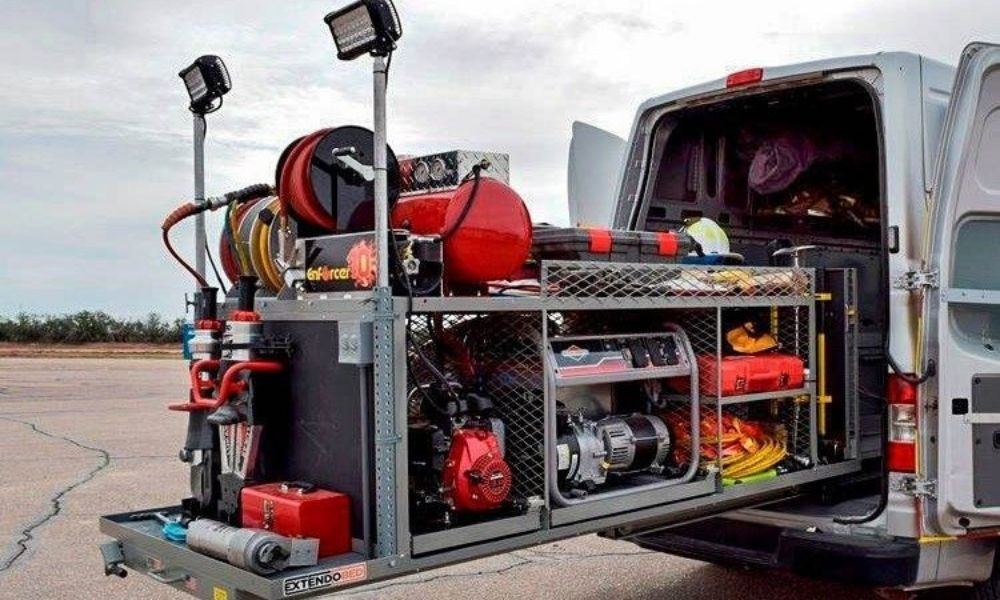
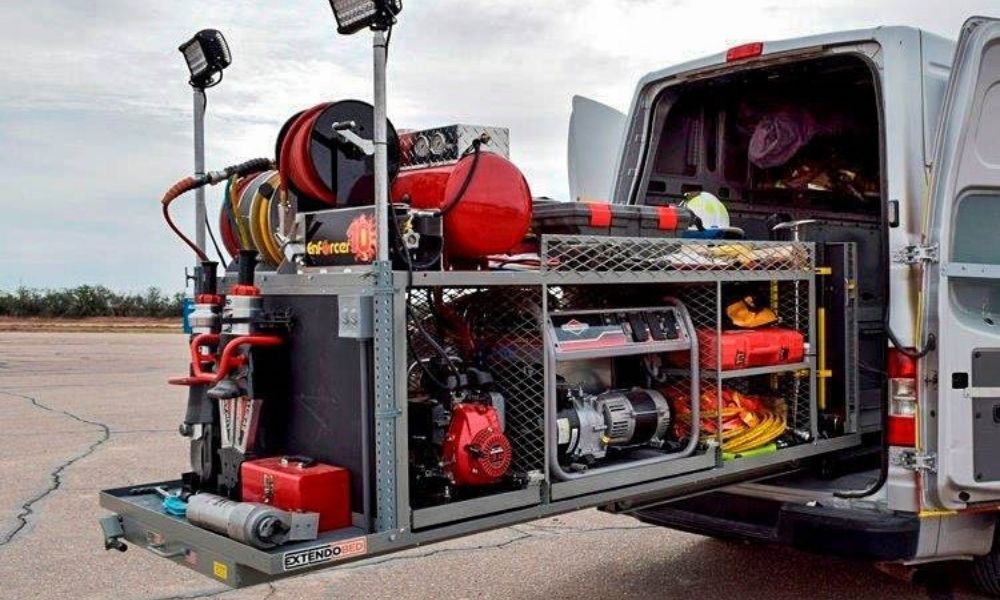
What does upfitting tend to look like? It all depends on the job. Utility companies upfit commercial vehicles to include ladders, cranes, and other implements for reaching the high places where lineworkers must do their jobs. Upfitting can even take on a 21st-century tone with office-oriented modifications to trucks and vans for skilled trade workers. Transporting lumber, heavy equipment, or other unwieldy cargo can call for a specially designed flatbed to accommodate their dimensions. When your trucks and jobs call for extremely generous bed capacity, our Extendobed can help. It can offer firefighters, law enforcement, and other working professionals unmatched versatility for carrying cargo and quickly accessing it multiple times throughout the day.

Why Does Upfitting Matter?

A factory-issue pickup truck is a jack of all trades. That, of course, makes it a master of none. That’s fine for weekend warriors and helpful neighbors. At a professional level, though, working vehicles require specialization. Upfitting doesn’t just make the job easier for the workers who need to complete their tasks. This investment in the tools of the trade confers a sense of professionalism to your business. An HVAC technician who pulls up in a van outfitted for specialized tasks inspires more confidence than one who shows up in a white Econoline that may as well have rolled off a used lot that morning. Being able to do the job more easily means more satisfied workers. And in a seller’s labor market, satisfied workers are more valuable than ever.

Upfit Your Trucks With an Extendobed

Upfitting your vehicle fleet and why it matters is highly relevant to fleet managers. When it comes to versatile upfits, few things matter more than the Extendobed. Our custom truck storage boxes boast over 110-percent extension – extension past the taillights™, up to 3,000 lbs. capacity, and durability that’ll last over 20 years. Contact us today to start upfitting your truck fleet.

Sticky

The Best Ways To Reduce Injuries on the Job Site

December 07, 2021

The Best Ways To Reduce Injuries on the Job Site

The Best Ways To Reduce Injuries on the Job Site

From improving morale to meeting legal obligations, there are dozens of reasons why every workplace should increase safety and lower worker injuries. That’s why it’s in everyone’s best interest to know the best ways to reduce injuries on the job site and put them into practice. This article will lay out some of the top practices for worker safety today.

Equipment: Efficient and Safe

Everyone understands your equipment has huge sway over the efficiency of your workers, no matter the job. But it also impacts the safety of your employees. When you’re upgrading or investing in your equipment, you shouldn’t just focus on productivity. You should aim for equipment that also bolsters safety because keeping your workers safe boosts their performance and reduces costs. Things like custom truck bed storage that increase worker capabilities and help workers unload items safely are prime examples.

Preventative Maintenance

One major step in protecting your employees is performing regular maintenance before it’s necessary. Lots of workplace injuries are preventable if people catch and fix the issues early. Preventative maintenance focuses on this idea by running frequent inspections and following repair schedules.

Training Sessions

Another one of the best ways to reduce injuries on the job site is to have training sessions that employees and managers take to learn more about safety. Finding out the proper and safest technique for any job is important for both efficiency and safety. Training sessions teach this information and encourage communication between workers as they take these classes together, lessening confusion and raising morale.

A Safety-First Mindset

One leading contributor to unsafe practices at work is a productivity-before-all-else mindset that permeates a workforce. When workers only worry about results, they make mistakes and rush through safety precautions. They can also tend to combining steps and procedures, which is a common cause of workplace injuries. Focus on changing your workplace into one that focuses on safety and worker health before results, and you’ll see a massive decrease in injuries.

These are the best steps you can take while reducing the risk of injuries to your workers. By changing your practices and ideologies, you can keep your workers safe and even boost performance because of it.

Sticky

The Gear Inside an Emergency Response Vehicle

November 24, 2021

The Gear Inside an Emergency Response Vehicle

The Gear Inside an Emergency Response Vehicle

Three major emergency response vehicle types are typically used across America: police vehicles, fire apparatus, and medical response vehicles. Although they carry similar supplies, there’s a lot of unique gear each type of vehicle must carry. Here’s a basic list of the gear inside an emergency response vehicle, minus the gear you’ll need for police vehicles, as we covered that topic recently.

Every Response Vehicle

Although response vehicles specialize in dealing with certain situations, there are plenty of tools they use across the board. Here’s a short list describing the typical gear response vehicles need.

  • Emergency Response Kits: These kits range from first aid kits to repair kits to specialty kits for each car. These kits are very useful in any emergency response vehicle, as they help responders deal with the most common situations they’ll face until the proper response team arrives.
  • High Visibility Jackets: High visibility jackets can make a huge difference during times of low visibility. Responders can wear these so anyone nearby can see them and react to their presence appropriately. Responders most often use these near roads, putting them on so drivers can see them and navigate around them.
  • Road Blockers: Oftentimes, responders can’t perfectly control an area and need space for their work. Road blockers help control traffic flow and enforce the safety of responders and individuals in the situation.
  • Flares: Light sources aren’t always available in dire situations, which is why flares can be so useful. They provide a lot of light and can mark areas very easily, making them useful for responders in various situations.
  • Tool Kit: In addition to an emergency response kit, every vehicle should carry a tool kit. Responders will encounter a wide variety of situations that require various tools. A tool kit will help resolve many common problems quickly.

These are the major pieces of gear that every response vehicle should always carry. This gear and the specialized equipment each type of vehicle brings along helps responders address any emergencies they might encounter.

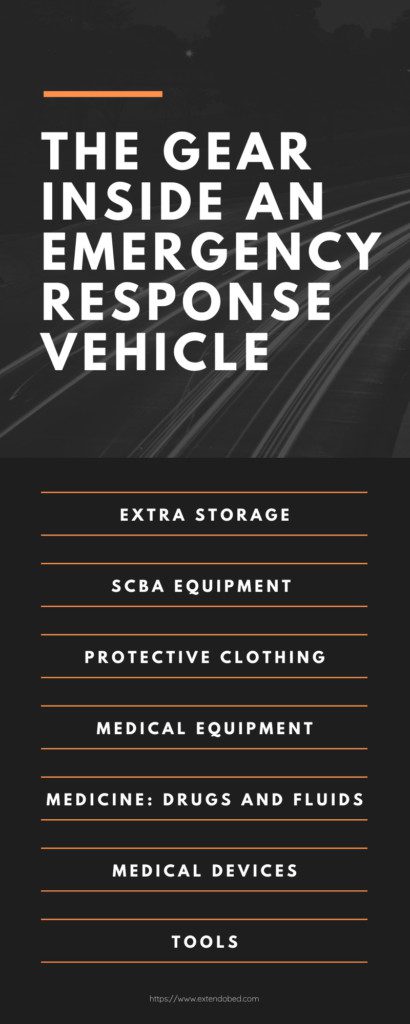
Extra Storage

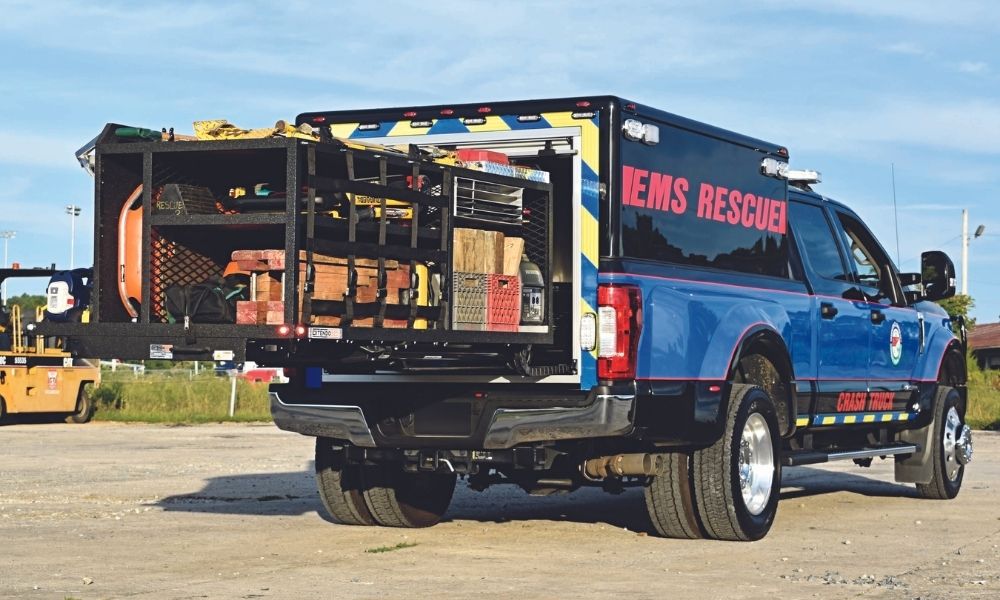
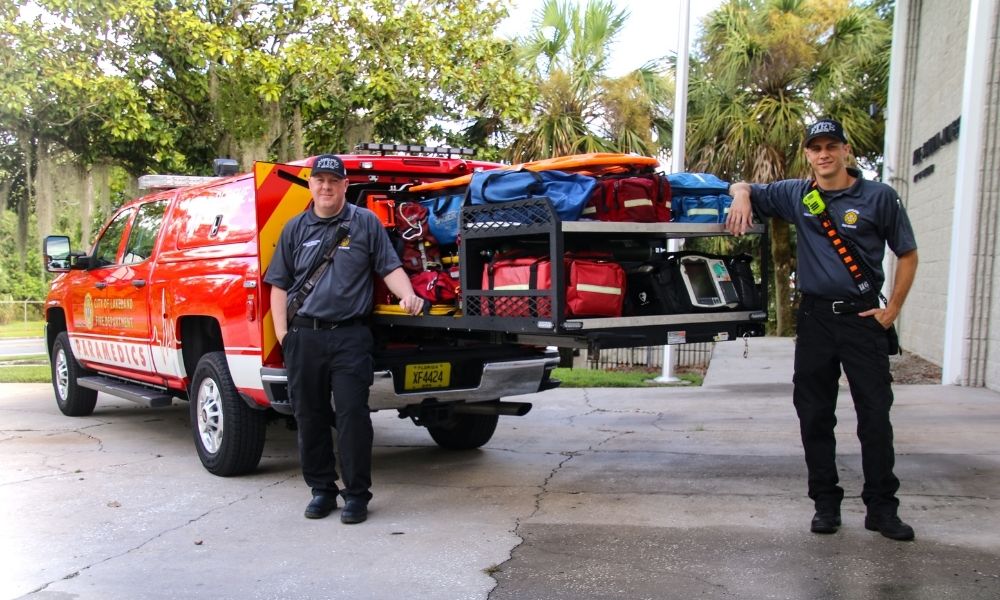
You might notice this is already a lot of gear, and it doesn’t even include the specialty equipment each responder type will need. Storing all the gear inside an emergency response vehicle, and then being able to quickly retrieve it, isn’t easy—in fact, it’s almost impossible without the aid of additional storage solutions. That’s why many response vehicles use aftermarket modifications, like the firefighter’s pull-out truck bed storage. This helps responders carry and quickly unload their gear with less risk to themselves.

Fire Apparatus

Fire apparatus are constantly mobilizing for various emergencies, arriving at the tamest to the most dangerous situations. They must carry a huge variety of gear for the different situations to which they respond. However, their main focus is fire suppression, which requires a lot of equipment that other vehicles don’t need. As the main job of a fire apparatus is controlling the spread of fires that may occur at any location, most of the equipment is for dealing with fires. From protective gear that helps firefighters approach a dangerous situation to the gear that helps suppress the fire, each fire apparatus carries it all wherever people need it. Here’s a deeper look into the tools and gear that fire apparatus carry.

Hoses, Foam, and Nozzles

The main equipment a fire apparatus carries is its tools for fire suppression: the hose and nozzles that shoot water and chemical fire suppressants. This can take up a lot of space in a vehicle and is why so many fire apparatus are so large. They carry tanks full of water and chemicals, plus the equipment for pumping it through the hoses.

SCBA Equipment

Another piece of gear that’s vital for a fire apparatus is the SCBA or self-contained breathing apparatus equipment. This gear helps professionals see and breathe in places with heavy smoke and fire, making it a vital part of any firefighter’s gear.

Protective Clothing

Just as the SCBA equipment helps with breathing near fire and smoke, protective clothing is necessary for firefighters in the same situations. These layers of clothing help protect firefighters from the heat and offer some padding, so having it readily available is important for success. In addition, many departments are requiring separate and sealed storage of protective clothing after an incident since there may have been toxic chemicals involved. This requires storage space as well.

Tools

There are dozens of other individual items that are useful for firefighters, so many vehicles carry them. Radios, hand lights, axes, ropes, and roof hooks are all items that every fire apparatus carries, and firefighters often use these in emergencies.

Ambulance/Medical Response Vehicle

Medical response vehicles are full of specialized gear with the sole purpose of saving lives, which is why they maximize their space utilization with medical devices and equipment. For a better understanding of what goes into a medical response vehicle, here’s a brief look at the gear you might find in an ambulance.

Medical Equipment

Each ambulance carries the equipment that best preserves life while on the move. Things like bandages and splints are very common equipment you’ll find in a medical response vehicle.

Medicine: Drugs and Fluids

Similarly, a lot of medical emergencies require medical drugs for stabilization and treatment. Things like sedatives and EpiPens are very common in ambulances, with whole cabinets dedicated to carrying emergency medicine. They also frequently carry intravenous fluids so people can get the liquids they need during transportation.

Medical Devices

Another category of gear ambulances carry includes medical devices that measure vitals and help stabilize people. This includes cardiac monitors, oxygen masks, and oxygen, which help professionals keep people alive during transport to the hospital.

Tools

Medical emergency response vehicles also need an array of tools many other response vehicles may or may not carry. Things like blankets, needles and scissors are vital tools for a response vehicle. Stretchers for carrying patients by foot may also be needed.

This list is only the general categories of items and equipment that you’ll find inside an emergency response vehicle. Each type of vehicle requires vastly different gear for different jobs, which is why the layout and size of each type of emergency response vehicle are so different. However, getting all the gear inside, and then being able to quickly access it and store it again is possible with proper planning, knowledge, and good storage solutions.

The Gear Inside an Emergency Response Vehicle
Sticky

What Equipment Does a K9 Officer Use

November 24, 2021

What Equipment Does a K9 Officer Use

What Equipment Does a K9 Officer Use

K9 officers have similar jobs to other police officers, but they differ because of the large animals they take with them to every job. These large furry friends help officers uncover vital information and arrest wrongdoers. However, a K9 unit requires a lot more than just a specially trained dog. There’s a lot of equipment and gear you’ll need for the K9. In this article, we’ll go over the equipment a K9 officer uses for their partner.

Animal Transport

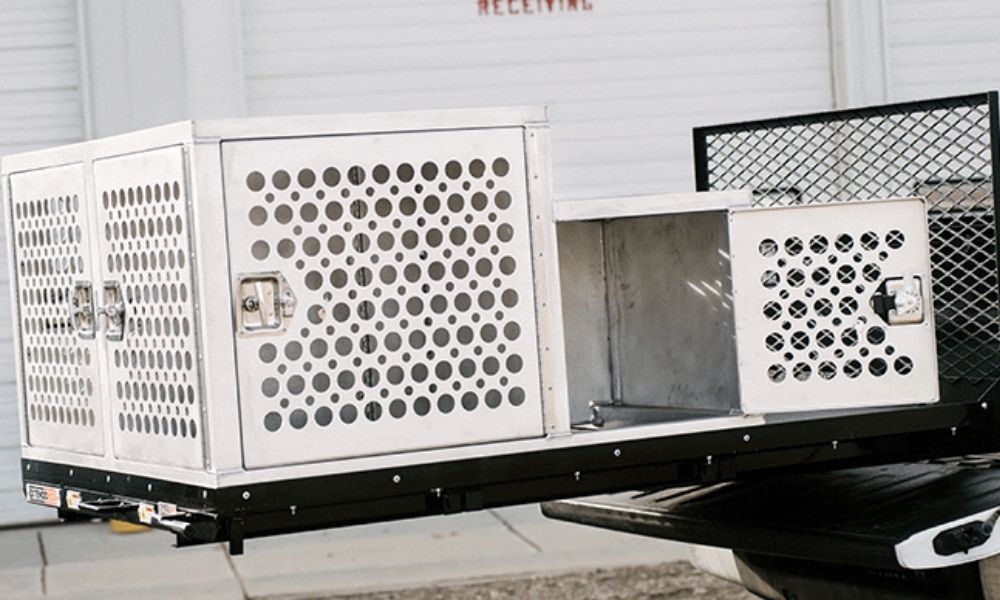
The biggest pieces of equipment that a K9 officer and dog team use is gear that helps with the transportation of the dog. A great example of this would include the giant cages you can find in the vehicle of any K9 officer. This helps keep everyone safe while the officer brings the dog from location to location.

Officer Protection

Although these K9 dogs receive extensive training before they join a team, there’s always a chance that the dog will need more training. In such instances, the training officer will wear equipment that’s comprised of a bite suit with full sleeves. This gear helps train police dogs without risking injuries on the people training them.

Harness and Leash

Even with all their training, police dogs still need leashes and harnesses that enable their partners to control them better. The harnesses can be very useful for the partners, as they can hold various first responders’ kits that may save lives when on the job.

Normal Police Equipment

All this specialty gear doesn’t include the regular items a dog might need or all the typical equipment already inside a police vehicle. Optimizing the space inside the vehicle is a top priority for K9 groups because of the additional equipment they carry. That’s why a lot of police departments use aftermarket modifications, like the slide-out truck bed storage, that help with organizing and maximizing the space in their vehicles.

This list should help you understand the equipment K9 units use for their job. Most of the equipment is for the protection of the dogs and people around them, making every piece of equipment extremely important for the job.

Sticky